Aerospace companies have moved from supporting roles to becoming the primary engines of space exploration. For decades, national agencies like NASA and the European Space Agency held near-exclusive authority over missions beyond Earth's atmosphere. That model has shifted decisively. Today, private firms design launch vehicles, build crew capsules, develop lunar landers, and operate orbital infrastructure alongside government agencies. The global space economy surpassed $600 billion in 2023, according to the Space Foundation, and a growing share of that figure flows through commercial contracts rather than purely public programs. Understanding how these companies operate, what they deliver, and where their limits lie matters for anyone tracking the future of space exploration, national competitiveness, or industrial investment in the sector.
Why aerospace companies are central to modern space exploration
The shift began gradually after the Apollo era, when NASA relied on large defense contractors to manufacture hardware under cost-plus contracts. Companies like Lockheed Martin, Boeing, and Northrop Grumman built satellites, spacecraft, and propulsion systems, but ownership and direction remained firmly with the government. The agency told industry what to build; industry built it.
That relationship changed structurally in the 2000s and 2010s. NASA's Commercial Orbital Transportation Services program introduced a new model: instead of purchasing hardware, the agency purchased services. Contractors invested their own capital, retained intellectual property, and competed for fixed-price milestones. SpaceX and Orbital Sciences (now part of Northrop Grumman) were the first beneficiaries. The results were faster development timelines and lower per-mission costs compared to traditional procurement.
Private capital accelerated the pace further. Blue Origin, funded by Jeff Bezos, and SpaceX, backed by Elon Musk's early investment, brought Silicon Valley-style iteration cycles into an industry historically defined by decade-long programs. These companies hired engineers away from legacy contractors and government labs, creating internal competition for talent and ideas.
The consequences reached beyond cost. Commercial firms introduced new manufacturing approaches, applied software-driven design tools, and brought vertical integration to rocket production. SpaceX manufactures roughly 70% of its components in-house, a strategy that compresses supply chains and accelerates design changes. This industrial depth gave aerospace companies the capacity to sustain exploration-class missions, not just commercial satellite launches.
NASA's fiscal year 2025 budget of approximately $24.8 billion reflects this mixed model. A significant portion funds commercial partnerships, including lunar landing services, crew transportation, and future orbital station development. Agencies no longer need to build everything themselves; they buy outcomes from companies that have the infrastructure to deliver them.
Read also: Key Factors Driving the Success of nasdaq: tsla Stocks
From launch vehicles to lunar systems: the capabilities they provide
The range of capabilities that aerospace companies now provide across the full exploration stack is broad. Each category represents a distinct engineering domain, and the firms involved often specialize before expanding.
- Launch vehicles: SpaceX's Falcon 9 and Falcon Heavy, United Launch Alliance's Vulcan Centaur, and Rocket Lab's Electron cover a spectrum from small satellite deployment to heavy-lift missions.
- Crew transportation: SpaceX's Crew Dragon has carried astronauts to the International Space Station under NASA's Commercial Crew Program; Boeing's Starliner is pursuing the same certification.
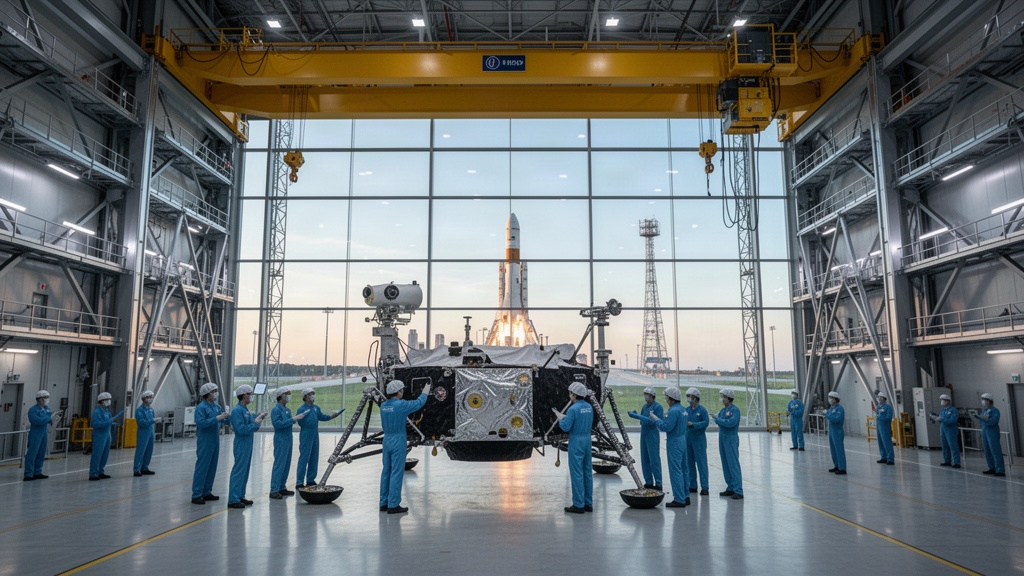
- Lunar landers: Intuitive Machines and Astrobotic operate under NASA's Commercial Lunar Payload Services program, delivering science instruments and technology demonstrations to the Moon's surface.
- Orbital infrastructure: Axiom Space is developing commercial modules that will attach to the ISS before eventually operating as a free-flying station.
- In-space servicing: Companies are developing vehicles capable of refueling, repositioning, or extending the life of satellites already in orbit, a capability with direct applications for deep-space logistics.
- Communications and data relay: Airbus Defence and Space and Thales Alenia Space supply satellite communication systems that connect ground teams with spacecraft across interplanetary distances.
The International Space Station, continuously inhabited since November 2000, demonstrates how deeply commercial capabilities are now woven into exploration operations. Resupply missions, crew rotations, hardware maintenance, and scientific payload delivery all depend on contracted services from private firms. Without that industrial base, sustained human presence in orbit would not be operationally viable at current budget levels.
How public-private partnerships accelerate missions
Public-private partnerships in space work differently from traditional government contracting. Under milestone-based agreements, NASA defines a technical outcome, sets a payment schedule tied to demonstrated progress, and allows the contractor to choose the engineering path. This structure transfers technical risk to the company while giving the agency predictable cost exposure.
The Commercial Crew Program illustrates the model's strengths. NASA provided roughly $6.8 billion across SpaceX and Boeing to develop independent crew transportation systems. SpaceX's Crew Dragon became operational in 2020, ending U.S. dependence on Russian Soyuz vehicles for station access. The speed of that development, measured against NASA's own estimates from the early 2000s, was notably faster under the commercial framework.
Risk sharing matters beyond cost. When Intuitive Machines landed its IM-1 lander on the Moon in early 2024, it marked the first American soft landing on the lunar surface in over 50 years. NASA paid for the service; Intuitive Machines owned the vehicle and the data rights. That ownership model incentivizes companies to invest beyond the immediate contract, building reusable platforms for future missions.
Read also: How Vxus is Changing the Landscape of Business Today
International partnerships add another layer. The European Space Agency contributes the service module for NASA's Orion spacecraft, built by Airbus Defence and Space. This arrangement distributes costs, spreads technical expertise across allied nations, and creates political durability for long-duration programs that span multiple government administrations.
The Federal Aviation Administration's Office of Commercial Space Transportation licenses and oversees commercial launches in the United States, a regulatory function that has grown substantially as launch frequency increased. Regulatory capacity now shapes mission timelines almost as much as engineering readiness.
Innovation, reusability and the changing economics of access to space
Reusability changed the arithmetic of launch economics more than any other single development. SpaceX's first successful recovery of a Falcon 9 first stage in December 2015 demonstrated that orbital-class boosters could land propulsively and fly again. Since then, individual Falcon 9 boosters have flown more than twenty times. The marginal cost of reusing a proven booster is substantially lower than manufacturing a new one, and that difference compounds across high-cadence launch schedules.
The effect on mission planning is direct. Constellations requiring dozens of launches, like SpaceX's Starlink or government broadband programs, became economically viable partly because per-launch costs fell. Science missions that previously waited years for a ride-share opportunity now have more frequent options at lower price points.
Miniaturization worked in parallel. Rocket Lab built its business on the premise that small satellites deserve dedicated launches rather than secondary slots on large vehicles. The Electron rocket, designed specifically for payloads under 300 kilograms, opened orbital access to universities, startups, and defense agencies that could not justify a full Falcon 9 manifest.
Read also: How are aerospace companies enhancing passenger safety
Standardization of interfaces, software architectures, and ground systems is reducing integration costs across the industry. When spacecraft components follow common standards, testing cycles shorten and cross-mission reuse becomes practical. These industrial efficiencies are less dramatic than a booster landing, but their cumulative effect on program timelines is significant.
Risks, limits and the future of the space industry
The commercial space model carries real vulnerabilities. Several prominent companies depend heavily on a small number of government contracts. If a program is cancelled, delayed, or restructured, the financial impact on a single contractor can be severe. Boeing's Starliner program experienced costly overruns and technical delays that required additional NASA funding to continue, illustrating how fixed-price contracts can strain companies when development proves more difficult than projected.
Orbital debris accumulation presents a structural problem for the entire industry. As launch cadence increases and constellations grow, the probability of collisions rises. No single company can solve this; it requires international coordination and regulatory frameworks that are still developing. The U.S. Space Force and NOAA both track debris, but mitigation rules remain inconsistent across national jurisdictions.
Industrial concentration is another concern. A handful of large firms, particularly SpaceX, hold dominant positions in launch, crew services, and satellite communications simultaneously. This vertical integration delivers efficiency but reduces redundancy. If a major provider faces a safety stand-down or supply chain failure, mission schedules across multiple agencies can stall.
Financing private space ventures remains difficult outside the United States. European firms like Thales Alenia Space and Airbus operate within a more fragmented funding environment, relying on ESA contracts and national agency programs that rarely match the scale of U.S. commercial investment. Bridging that gap will determine whether space exploration remains a largely American commercial enterprise or becomes genuinely multinational at the industrial level.
The next decade will test whether the current model scales to Mars-class missions, commercial space stations, and lunar infrastructure. Those programs require sustained capital, engineering depth, and regulatory stability that no single company or contract cycle can guarantee. The Artemis program, the development of commercial orbital stations, and emerging in-space servicing markets will each stress-test assumptions that have held in low Earth orbit but remain unproven at greater distances and longer timescales.