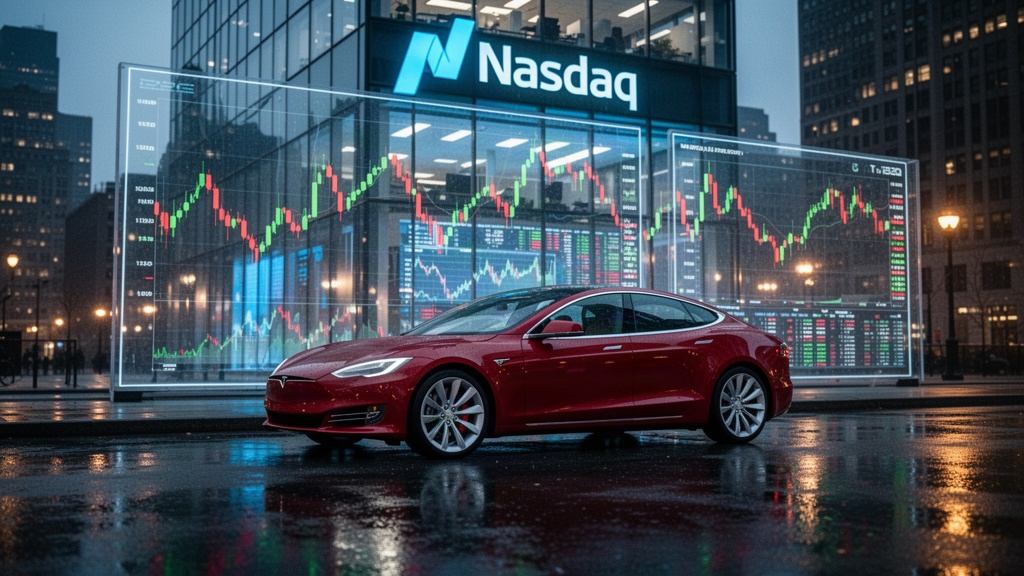
NASDAQ: TSLA has never been a quiet stock. Since Tesla's listing on the Nasdaq Stock Market, its share price has swung between euphoric highs and brutal corrections, often disconnecting from the company's actual operating results. Entering 2026, that tension is sharper than ever. Tesla reported revenues of approximately $97.69 billion in 2024, delivered 1,789,226 vehicles, and posted a net profit of around $7.09 billion — figures that confirm a real, profitable business. Yet the stock's valuation multiples remain far above those of traditional automakers, which means any disappointment on deliveries, margins, or future growth narratives can trigger outsized price moves. Understanding whether TSLA can hold its ground requires separating what the company actually earns today from what the market is pricing in for tomorrow.
Why NASDAQ: TSLA Remains Especially Sensitive to Market Swings
Volatility is not an accident for TSLA — it is a structural feature. The stock trades as a hybrid between a consumer automotive company and a high-growth technology firm, which means it attracts two very different investor bases with conflicting time horizons. When the Federal Reserve signals tighter monetary policy, growth multiples compress across the board, and Tesla's elevated price-to-earnings ratio makes it one of the first casualties. When rate expectations ease, the reverse happens just as fast.
The stock's drawdown history is striking. TSLA has experienced multiple declines exceeding 50% from peak to trough over its listed life, followed by equally dramatic recoveries. That pattern does not reflect a broken business — it reflects a valuation that prices in scenarios ranging from "dominant global automaker" to "AI and robotics platform." Each new data point, whether a quarterly delivery miss or a regulatory filing with the SEC, gets amplified through that lens.
Macroeconomic conditions in 2026 add another layer of complexity. Interest rate decisions by the Federal Reserve directly affect the discount rate applied to Tesla's future cash flows. If borrowing costs remain elevated, consumers also face higher financing costs on vehicle purchases, which can soften demand precisely when Tesla needs volume to defend its margins. Geopolitical friction, particularly around trade tariffs affecting battery materials and finished vehicles, creates a further source of unpredictable pressure on the stock.
Sentiment around Elon Musk himself amplifies these swings. His public statements, business decisions at other ventures, and political visibility generate headlines that move TSLA independent of any financial result. That personal brand exposure is a risk factor with no direct parallel among other large-cap stocks.
The Fundamentals That Actually Determine Resilience
Before debating where the stock goes, the operating numbers deserve a clear read. Tesla's operating margin stood at approximately 7.2% in 2024, down from the peaks above 17% reached in 2022. That compression came primarily from aggressive price cuts deployed to defend market share against growing competition. Whether that margin stabilizes, recovers, or erodes further in 2026 is arguably the single most watched metric among institutional investors.
Read also: The Impact of the SP 500 on Small Business Investments
Free cash flow generation matters more than headline profits for a capital-intensive business. Tesla has historically maintained a positive free cash flow position, which gives it the ability to fund new factories, research programs, and product launches without relying on external debt markets. Any deterioration in that position would change the risk profile of the stock significantly.
The revenue mix is also shifting. Energy generation and storage — including the Megapack product line — has become a faster-growing segment than the automotive business in recent quarters. Services and software revenues, while still a smaller share of the total, carry higher margins than vehicle sales. If these segments continue expanding their contribution through 2026, they could partially offset pressure on automotive margins.
Delivery volumes remain the market's preferred pulse check. Tesla delivered just under 1.8 million vehicles in 2024. Whether 2026 volumes grow, stagnate, or decline depends on new model launches, factory utilization at plants in Fremont, Austin, Berlin, and Shanghai, and the competitive environment in each regional market. A return to meaningful volume growth would likely be the strongest single catalyst for the stock.
Competitive Pressure, Pricing, and the Demand Question
BYD has become Tesla's most direct global rival, competing across multiple price points and posting delivery volumes that have surpassed Tesla's in certain periods. The broader competitive field has also expanded: Volkswagen Group, General Motors, Ford, and Hyundai Motor Group have all accelerated their electric vehicle programs, filling gaps in segments where Tesla once operated with little direct competition.
Price cuts were Tesla's primary tool for maintaining volume in 2024, and they worked — but at a cost to margins. The question for 2026 is whether Tesla can hold pricing without losing share, or whether further reductions become necessary as competitors reach cost parity. Battery costs have fallen across the industry, which narrows Tesla's historical manufacturing cost advantage.
Read also: How to Analyze the Valuation of Palantir Stocks
Government incentives in the United States, managed partly through the U.S. Department of Energy and shaped by federal tax policy, have influenced EV purchase decisions significantly. Any reduction or restructuring of those incentives affects demand disproportionately for higher-priced vehicles, which includes several Tesla models. The EPA and NHTSA regulatory environment also shapes product development costs and timelines.
Demand in China, Tesla's second-largest market, carries particular weight. Local competition from BYD and other domestic brands is intense, and geopolitical tensions between the US and China introduce a risk that goes beyond normal commercial competition. A sustained loss of market share in China would be difficult to offset with growth elsewhere in the near term.
Robotaxis, AI, and Energy: Revenue Today Versus Promises for Later
Tesla's long-term valuation rests heavily on businesses that do not yet generate material revenue. Full Self-Driving technology, robotaxi deployment, and the Optimus humanoid robot program are regularly cited as reasons to assign Tesla a multiple far above that of a conventional automaker. The logic is straightforward: if any of these platforms scales commercially, the revenue and margin potential dwarfs the existing vehicle business.
The gap between potential and proof remains wide. Autonomous driving technology is subject to regulatory approval processes managed by NHTSA and state-level authorities, and timelines for commercial robotaxi operations have been pushed back repeatedly. Investors pricing these scenarios into the stock today are making a bet on execution and regulatory clearance, not on existing financial results.
The energy storage business is a different story. Megapack deployments are happening now, contracts are being signed, and revenue is being recognized. The International Energy Agency projects continued strong growth in grid-scale battery storage globally, which positions Tesla's energy segment as a genuine near-term growth driver rather than a speculative one.
Read also: Key Factors Driving the Success of nasdaq: tsla Stocks
Software and services revenue, including FSD licensing and over-the-air updates, has the potential to generate recurring, high-margin income at scale. The Tesla Investor Relations filings show this segment growing, but it has not yet reached a size that materially changes the company's overall margin profile.
Three Scenarios for TSLA Through 2026
No forecast about TSLA carries certainty. What follows are three distinct scenarios built on explicit assumptions, not predictions dressed up as analysis.
| Scenario | Demand & Deliveries | Margin Trend | Competitive Pressure | Energy & Software | Key Risks | Valuation Implication |
|---|---|---|---|---|---|---|
| Bearish | Deliveries stagnate or decline below 2024 levels; no major new model traction | Operating margin falls below 6% on continued price cuts | BYD and legacy OEMs take share in China and Europe | Energy grows but cannot offset automotive weakness | Rate pressure, demand shortfall, China market loss, FSD delays | Multiple compression; stock revisits lower historical valuation bands |
| Base | Modest delivery growth of 5–10% year-on-year; new models contribute incrementally | Operating margin stabilizes between 7–9% | Competition intensifies but Tesla holds core markets | Megapack revenue grows meaningfully; software revenues rise gradually | Execution risk on new platforms, macro uncertainty | Stock trades in line with current multiples; limited re-rating without a catalyst |
| Bullish | Deliveries accelerate above 2.2 million; new affordable model drives volume | Operating margin recovers above 10% on cost efficiencies and software mix | Tesla widens lead in software and autonomy versus legacy competitors | FSD monetization begins at scale; energy segment doubles revenue | Regulatory approval timelines, execution of robotaxi rollout | Significant multiple expansion; stock re-rates toward technology peers |
The base scenario is not the most exciting, but it reflects the most probable path given current operating trends. Tesla's balance sheet remains strong enough to weather a bearish year without existential risk. The bullish scenario requires several things to go right simultaneously — cost reductions, volume growth, and at least partial FSD monetization — which is possible but not guaranteed.
What separates TSLA from most stocks is that the bearish and bullish scenarios are both plausible at the same time, depending on which segment you weight most heavily. That ambiguity is exactly what drives the stock's volatility, and it will not resolve quickly. Investors watching TSLA in 2026 should track operating margin and delivery growth above all else — those two numbers will signal which scenario is unfolding before the market fully prices it in.
This article is informational only and does not constitute a personalized investment recommendation. Past performance of TSLA does not guarantee future results.