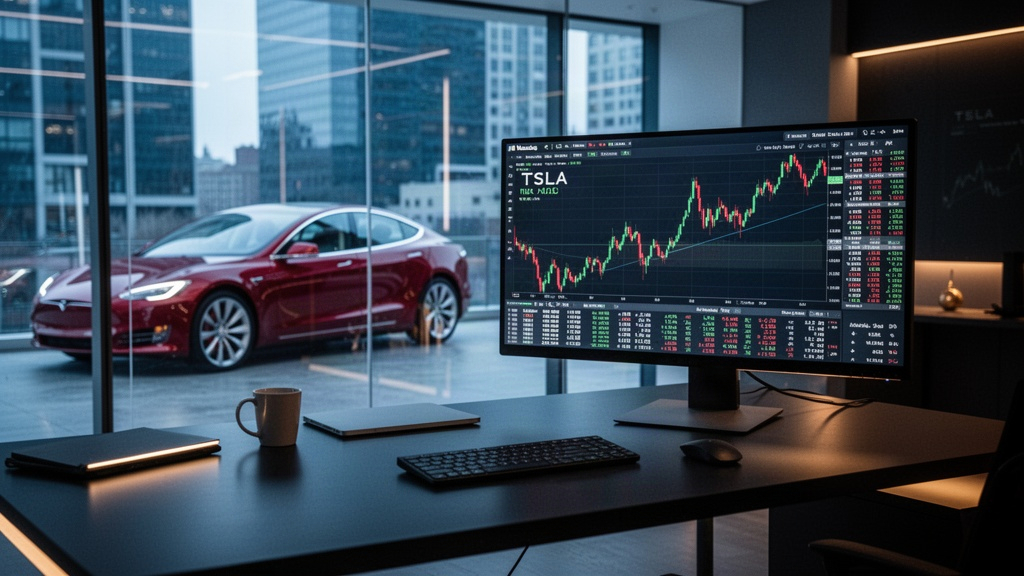
Nasdaq: TSLA is one of the most watched stock tickers on American financial markets. Since Tesla, Inc. listed on the Nasdaq Stock Market in 2010, its shares have attracted both institutional investors and retail traders drawn to the company's growth trajectory. Few stocks generate as much debate: some analysts see TSLA as a technology company wearing an automotive costume, while others evaluate it purely on vehicle delivery numbers. Understanding what actually moves this stock requires looking beyond headlines at the underlying business drivers, financial metrics, and structural risks. The key factors covered below include delivery volumes, energy storage expansion, margin dynamics, software monetization, and competitive pressures. Each element shapes how the market prices TSLA at any given moment.
How Nasdaq: TSLA Fits Into the Broader Market
Tesla, Inc. trades under the ticker TSLA on the Nasdaq Stock Market, the electronic exchange best known for listing technology and high-growth companies. The ticker functions as a unique identifier across brokerage platforms, trading terminals, and financial data feeds. When investors reference "TSLA," they are referring to common shares of Tesla registered with the U.S. Securities and Exchange Commission (SEC), with filings publicly available through the EDGAR database.
Tesla's market profile sits in an unusual category. Its primary revenue comes from manufacturing and selling electric vehicles, yet its valuation multiples have historically resembled those of software companies rather than traditional automakers. This gap between conventional automotive peers like General Motors or Ford and Tesla's stock price reflects market expectations about future earnings, not just current profitability.
Several standard metrics shape how analysts evaluate TSLA. Market capitalization — the share price multiplied by total shares outstanding — fluctuates daily and has at times placed Tesla among the ten largest publicly traded companies in the United States. The price-to-earnings ratio signals how much investors are willing to pay per dollar of profit, while trading volume indicates market conviction on any given day. Quarterly earnings calls and delivery reports published by Tesla Investor Relations consistently move the stock in both directions.
The company's 2010 IPO raised capital that funded its first mass-market expansion. Since then, TSLA has split its shares twice, increasing accessibility for retail investors. Regulatory filings — particularly the annual 10-K and quarterly 10-Q forms submitted to the SEC — remain the most reliable source for understanding the business behind the ticker.
Electric Vehicles and Energy Storage as Growth Engines
Tesla's vehicle delivery numbers are the single most closely watched operational metric. In 2024, the company delivered 1,789,226 vehicles globally, with the Model 3 and Model Y accounting for the vast majority. While that figure represented a slight year-over-year decline from 2023 levels, it underscored Tesla's position as the world's largest dedicated electric vehicle manufacturer by volume.
Read also: Why understanding what are the bonds is crucial for success
Production capacity matters as much as current output. Tesla operates Gigafactories in Nevada, Texas, Shanghai, and Berlin, with each facility designed to reduce per-unit manufacturing costs through vertical integration and scale. The Shanghai plant alone has become a major export hub for European and Asian markets, reducing logistics costs compared to U.S.-based production.
The energy generation and storage segment has grown at a rate that now demands separate attention from investors. Megapack battery systems deployed for grid-scale storage and Powerwall units for residential use contributed meaningfully to Tesla's 2024 revenue of $97.69 billion. This segment carries different margin characteristics than vehicle sales and provides some insulation against automotive demand cycles.
New model introductions remain a potential demand catalyst. The Cybertruck, which began limited deliveries in late 2023, added a new price tier and customer segment. Any acceleration in deliveries for newer models, or the commercial launch of more affordable vehicles targeting broader global markets, would directly affect volume forecasts and, by extension, TSLA's stock price. The U.S. Department of Energy's Alternative Fuels Data Center tracks EV adoption trends that provide useful context for demand projections.
Margins, Cash Flow, and What They Signal to Investors
Tesla's net income attributable to common shareholders reached approximately $7.13 billion in 2024. That figure reflects the impact of price reductions Tesla implemented throughout the year to defend market share against intensifying competition from BYD, Volkswagen Group, and domestic Chinese manufacturers. Price cuts expand volume but compress margins, and that tension has been central to TSLA's stock volatility.
Operating margin — the share of revenue remaining after operating expenses — is the metric Wall Street scrutinizes most carefully each quarter. When Tesla's operating margin declined from double digits to the mid-single digits during 2023 and 2024, the stock reacted sharply. Recovery toward higher margin levels, driven by cost reductions in battery production or manufacturing efficiency gains, would represent a meaningful positive signal.
Read also: The critical role of aerospace companies in space exploration
Free cash flow tells a different story from net income. After accounting for capital expenditures on new factories and equipment, Tesla's ability to generate cash organically demonstrates financial resilience. Strong free cash flow allows the company to fund R&D, service any debt, and maintain flexibility without constant equity issuance. Investors tracking TSLA should read the cash flow statement in Tesla's SEC filings alongside the income statement.
Raw material costs — particularly lithium, nickel, and cobalt for battery production — directly affect cost of goods sold. When commodity prices fall, Tesla's unit economics improve without requiring price increases. The company's vertical integration strategy, including its proprietary 4680 battery cell program, aims to reduce dependence on external suppliers and structurally lower production costs over time.
Software Revenue, Autonomous Driving, and Future Valuation Levers
A significant portion of Tesla's premium valuation rests on anticipated revenue streams that go beyond selling cars. Full Self-Driving (FSD) software, sold as a subscription or one-time purchase, generates high-margin revenue attached to vehicles already on the road. As the installed base of Tesla vehicles grows, so does the potential recurring revenue from software upgrades and feature unlocks.
The Autopilot and FSD systems are subject to ongoing regulatory oversight by the National Highway Traffic Safety Administration (NHTSA), which has investigated multiple incidents involving Tesla's driver assistance technology. It is worth distinguishing between what is currently available and authorized versus what Tesla has projected for future capabilities. Investors should treat autonomous robotaxi projections as long-term possibilities, not near-term revenue certainties.
Tesla's work in artificial intelligence and neural network training, supported by its Dojo supercomputer program, positions the company in the AI infrastructure space. Whether this translates into licensable technology or remains proprietary to Tesla's own systems remains an open question. Financial analysts at major institutions have assigned varying valuations to this segment, reflecting genuine uncertainty rather than consensus.
Read also: Your Guide on How to Invest in Stocks for Maximum Profit
Services revenue, including vehicle insurance, charging network fees, and over-the-air software updates, adds another layer of recurring income. The Supercharger network, now partially opened to non-Tesla vehicles, generates fees while strengthening the broader EV ecosystem argument for Tesla's platform value.
Risks Worth Weighing Before Assessing TSLA's Trajectory
No analysis of TSLA is complete without a direct look at the factors that can push the stock lower. The following points represent the primary risks that investors and analysts monitor:
- Competitive pressure from BYD, Volkswagen Group, and emerging Chinese manufacturers is intensifying, particularly in the affordable EV segment where Tesla has historically had limited presence.
- Margin compression from sustained price reductions could erode profitability even as delivery volumes grow, creating a divergence between operational scale and financial returns.
- Interest rate sensitivity affects both Tesla's consumer financing costs and the discount rate applied to future earnings in valuation models — higher rates reduce the present value of growth stocks.
- Regulatory and safety risks, including NHTSA investigations, EPA compliance requirements, and potential recalls, can generate negative headlines and legal costs simultaneously.
- Valuation premium relative to traditional automakers means TSLA requires consistent execution on growth expectations; any shortfall in deliveries or guidance tends to produce outsized stock declines.
Beyond these structural factors, governance considerations matter. CEO Elon Musk's public statements and activities outside Tesla have periodically influenced TSLA's share price in both directions. Institutional investors increasingly factor leadership focus and corporate governance practices into their assessment of stock risk.
The global EV policy environment also shapes demand. Federal tax credits under U.S. legislation, state-level incentives, and international subsidy programs affect the effective purchase price for consumers. Changes to these programs — which vary by jurisdiction and are subject to legislative revision — can shift demand forecasts materially. The Environmental Protection Agency's emissions standards create a regulatory tailwind for EV adoption broadly, but the specific benefit to Tesla depends on how competitors respond.
TSLA's stock price reflects a continuous negotiation between the company's demonstrated financial results and the market's expectations for what Tesla becomes over the next decade. That gap between present earnings and future potential is precisely what makes TSLA one of the most actively traded and debated stocks on the Nasdaq today.