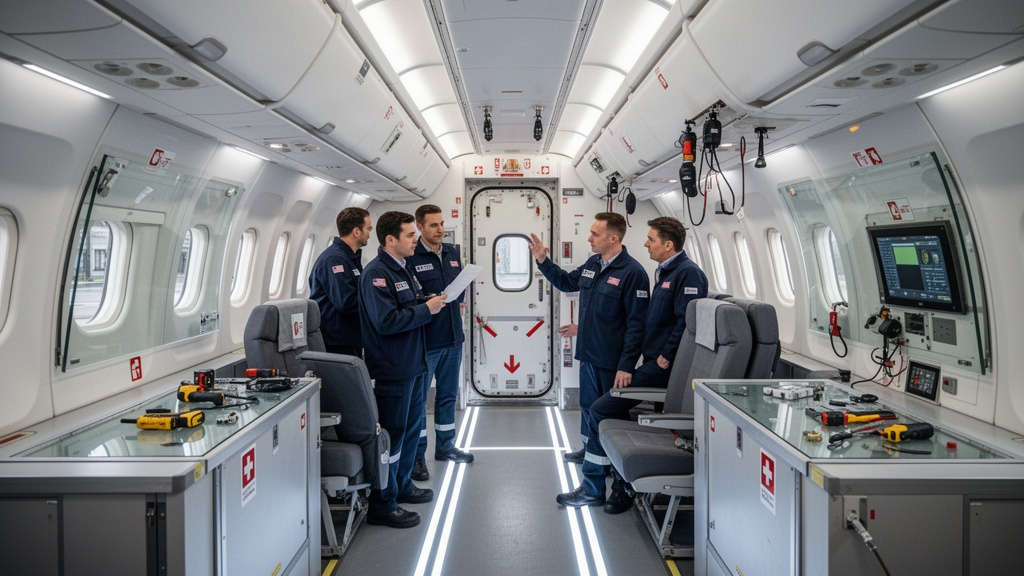
Aerospace companies sit at the intersection of engineering ambition and public responsibility. Every commercial flight carries passengers who trust that the aircraft surrounding them has been designed, tested, and maintained to the highest possible standard. That trust is not accidental. It results from decades of accumulated regulation, engineering discipline, and data-driven decision-making. According to IATA figures, commercial aviation recorded approximately 30 accidents across roughly 37 million flights in 2023, a ratio that reflects systematic safety work rather than good fortune. Behind those numbers are manufacturers, suppliers, regulators, and operators who have built overlapping layers of protection into every phase of an aircraft's life. Understanding how those layers work reveals why flying remains one of the safest forms of travel available.
How aerospace companies build safety into aircraft design
Safety in aviation begins long before a passenger boards a plane. Boeing, Airbus, and their suppliers embed protection into the fundamental architecture of every aircraft they produce. The governing principle is redundancy: no single failure should be capable of causing a catastrophic outcome. Flight control systems run on multiple independent channels. Hydraulic circuits are duplicated or triplicated. Electrical power comes from separate generators with battery backup. If one system fails, another takes over automatically.
Structural design follows equally rigorous standards. Under 14 CFR Part 25, the FAA's airworthiness rules for transport-category aircraft in the United States, manufacturers must demonstrate that airframes can withstand loads well beyond anything they are expected to encounter in service. Fire protection receives dedicated attention: engine nacelles, cargo holds, and cabin materials must all meet strict flammability and suppression requirements. Seat structures and restraint systems are tested to defined dynamic load criteria to protect occupants during emergency landings.
Cabin design itself contributes to passenger survival. Emergency exit placement, aisle width, lighting systems, and evacuation slide performance are all specified by regulation and validated through timed evacuation demonstrations before an aircraft enters service. The following layers of protection are built into every certified commercial transport aircraft:
- Redundant flight control systems with independent hydraulic and electrical channels
- Automated fault detection that alerts crews to system degradation before failure occurs
- Fire suppression systems in engines, cargo holds, and lavatories
- Structural load margins validated through ground and flight testing under FAA Part 25 or EASA CS-25 standards
- Emergency evacuation provisions including exit lighting, slide systems, and crew procedures
Companies like RTX, through its Collins Aerospace and Pratt & Whitney divisions, and Safran supply many of these critical components. Their engineering choices, governed by type certification requirements, directly determine how much protection passengers receive when something goes wrong.
From testing to certification: proving an aircraft is safe
Designing a safe aircraft and proving it is safe are two separate challenges. Type certification is the formal process through which a civil aviation authority verifies that a new aircraft model meets all applicable technical and safety requirements before it carries a single paying passenger. In the United States, the Federal Aviation Administration oversees this process. In Europe, the European Union Aviation Safety Agency holds equivalent authority.
Read also: Your Guide on How to Invest in Stocks for Maximum Profit
The certification process combines analysis, ground testing, and flight testing across thousands of hours. Engineers simulate failures deliberately: they shut down engines, jam control surfaces, depressurize cabins, and introduce electrical faults to confirm that the aircraft responds as designed. Flutter testing pushes airframes to speeds beyond their intended operational envelope to verify structural integrity. Brake performance is measured on hot, contaminated runways. Every test result feeds into a compliance finding that the authority must accept before granting certification.
GE Aerospace and other engine manufacturers undergo a parallel certification process for powerplants, including bird-ingestion tests, blade-containment demonstrations, and endurance runs that simulate years of operational cycles compressed into weeks. The engine and airframe certifications are then combined to produce a complete type certificate for the aircraft.
Certification does not end at entry into service. Manufacturers must report and investigate any in-service findings that could affect airworthiness, and regulators can issue Airworthiness Directives requiring operators to carry out specific inspections or modifications. The NTSB in the United States investigates accidents and issues safety recommendations that frequently lead to design changes or new certification requirements. This continuous feedback loop between operations and certification keeps safety standards moving forward rather than fixed at the moment of initial approval.
Using data and maintenance to prevent failures
Modern commercial aircraft generate enormous volumes of operational data during every flight. Sensors embedded throughout the airframe and engines monitor temperatures, pressures, vibration signatures, fluid levels, and hundreds of other parameters in real time. Flight data monitoring programs collect and analyze this information after each flight to identify trends, detect deviations from normal operating profiles, and flag components that show early signs of degradation.
Predictive maintenance takes that analysis a step further. Rather than replacing components on a fixed schedule or waiting for a failure to occur, maintenance teams use sensor data and algorithmic models to intervene at the right moment, before a problem becomes a safety event. Airlines working with engine manufacturers like GE Aerospace and Pratt & Whitney receive continuous health monitoring data that can trigger maintenance actions days or weeks before a component would otherwise fail.
Read also: What makes a successful restaurant chain stand out today
Ground inspection programs complement the data-driven approach. Airworthiness requirements mandate regular checks at defined intervals, ranging from daily walk-around inspections to heavy maintenance visits that can take weeks and involve disassembling major structural sections. Technicians use ultrasonic, eddy-current, and other non-destructive testing methods to detect cracks or corrosion that are invisible to the naked eye.
The combination of real-time monitoring, predictive analysis, and scheduled inspection creates a maintenance environment where the probability of an undetected failure reaching a critical stage is extremely low. ICAO standards and national regulations both require operators to maintain documented maintenance programs approved by their national aviation authority, ensuring that these practices are not optional.
Managing human factors, training, and operational risk
Technology alone cannot eliminate accidents. Human factors research has consistently shown that crew communication, workload management, and decision-making under pressure influence outcomes as much as hardware. The aviation industry has developed structured responses to this reality.
Crew Resource Management training, now standard across commercial aviation, teaches flight crews to communicate assertively, challenge each other's decisions when necessary, and manage the cognitive demands of abnormal situations. Simulator training exposes crews to emergency scenarios that would be impossible to practice safely in a real aircraft. Recurrent training requirements mean that pilots and cabin crew revisit emergency procedures regularly throughout their careers.
The NASA Aviation Safety Reporting System provides a confidential channel through which pilots, controllers, and maintenance technicians can report safety concerns without fear of punitive action. This voluntary reporting generates data that safety analysts use to identify systemic risks before they produce accidents. Airlines with mature safety cultures actively encourage their staff to use such systems and treat every report as useful information rather than a liability.
Read also: The Future of SandP500: Predictions for 2026 and Beyond
Safety Management Systems, which the FAA has required of U.S. airlines operating under Part 121 regulations since 2015, formalize this approach. An SMS combines hazard identification, risk assessment, safety assurance, and safety promotion into a structured organizational framework. The FAA published a rule in 2024 extending SMS obligations to additional categories of aviation organizations, reflecting the agency's view that systematic risk management should apply across a wider portion of the industry.
How regulation and supply-chain oversight raise safety standards
No aerospace company operates in isolation. A modern commercial aircraft contains components sourced from hundreds of suppliers across multiple countries. The safety of the finished product depends on the quality of every part in that chain, which is why regulatory oversight now extends well beyond the aircraft manufacturer itself.
The FAA and EASA both require manufacturers to maintain approved supplier oversight programs, verifying that parts meet design specifications and that manufacturing processes are controlled. Following high-profile quality concerns at major manufacturers in recent years, regulators have intensified audits of production facilities and supplier networks. The FAA increased its oversight of Boeing's production system, for example, requiring the company to demonstrate improvements in quality management before approving production rate increases.
Cybersecurity has become an active area of regulatory attention. Aircraft systems increasingly rely on digital networks, and the aviation sector has recognized that software vulnerabilities can affect safety as directly as mechanical failures. Both the FAA and EASA have issued guidance requiring manufacturers to address cybersecurity threats as part of the certification process for new aircraft and major modifications.
ICAO sets international standards through its Standards and Recommended Practices, which member states incorporate into national law. This framework means that an aircraft certified in the United States and operated in the United Kingdom or Australia must meet a consistent baseline of safety requirements, regardless of where it was built or registered. The result is a global safety architecture where improvements made in one jurisdiction tend to propagate across the entire industry over time, raising the floor for every passenger on every flight.