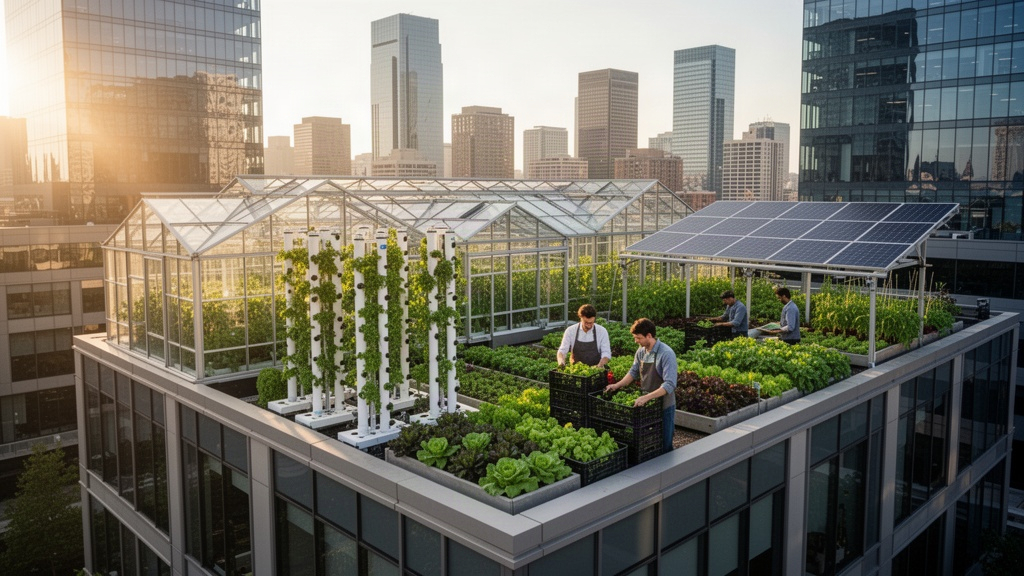
Urban farming has moved well beyond community garden plots and rooftop experiments. Across the United States and the United Kingdom, entrepreneurs, investors, and local authorities are treating food production inside city limits as a serious commercial sector. The drivers are real: rapid urbanization, growing consumer demand for fresh local produce, and persistent vulnerabilities in long-distance supply chains exposed by recent global disruptions. At the same time, the sector is maturing past its early hype. Several large-scale vertical farming ventures have struggled financially, while more targeted, lower-overhead models are demonstrating that profitability is achievable. Understanding where the genuine opportunities lie — and where the risks are underestimated — is what separates a viable urban agriculture business from an expensive experiment.
Why urban farming is becoming a serious business opportunity
Cities concentrate both demand and distribution infrastructure. A farm located inside or adjacent to an urban center can supply restaurants, grocery retailers, and direct-to-consumer markets with perishable produce that arrives fresher than goods shipped across the country. That proximity translates into a measurable commercial advantage for high-value, short-shelf-life products like microgreens, fresh herbs, and specialty salad leaves.
Supply chain fragility has pushed food procurement managers at restaurant groups and retailers to diversify sourcing. A local urban farm offering consistent weekly volumes becomes an attractive alternative to distant suppliers vulnerable to weather, logistics delays, or price volatility. This shift in procurement thinking has opened contract opportunities that simply did not exist five years ago.
Public policy is moving in the same direction. The USDA's Urban Agriculture and Innovative Production programs provide grants and technical assistance to urban growers in the United States. In the UK, DEFRA has supported local food system initiatives as part of broader environmental land management reforms. Neither program guarantees profitability, but both reduce the barrier to entry for new operators.
Demographic trends reinforce the commercial case. Urban consumers increasingly associate local production with quality, transparency, and reduced environmental impact. That willingness to pay a premium for locally grown produce is the commercial foundation on which viable urban farming businesses are built. The premium is not unlimited, and pricing discipline matters, but the market signal is consistent across major English-speaking cities.
The main production models compared
No single format suits every operator. The choice between a vertical indoor farm, a rooftop greenhouse, a hydroponic container unit, or a community production site depends on available capital, target market, real estate access, and operational complexity tolerance. Each model carries a distinct cost structure and commercial logic.
Read also: Why understanding what are the bonds is crucial for success
| Model | Relative investment | Energy use | Best-suited crops | Commercial outlets | Main advantage | Main limit | Regulatory complexity |
|---|---|---|---|---|---|---|---|
| Indoor vertical farm | High to very high | Very high (LED, HVAC) | Leafy greens, herbs, microgreens | Retailers, restaurants, online | Year-round, space-efficient | Energy costs, high capex | Medium to high |
| Rooftop greenhouse | Medium | Medium (natural light supplement) | Tomatoes, herbs, salads | Local restaurants, farmers markets | Natural light reduces energy bill | Structural load, planning permission | Medium |
| Hydroponic container farm | Low to medium | Medium | Microgreens, herbs, lettuce | Restaurants, direct sales | Modular, relocatable | Limited volume per unit | Low to medium |
| Community farm | Low | Low | Mixed vegetables, fruit | Local market, CSA boxes | Low overhead, community support | Lower margins, seasonal | Low |
Hydroponics and aquaponics sit across several of these formats. Hydroponic systems deliver nutrients directly to plant roots in water, eliminating soil entirely and allowing precise control over growth conditions. Aquaponic setups integrate fish production, with nutrient-rich fish waste feeding plant growth in a closed loop. Both approaches suit indoor and container environments particularly well.
Operators like Gotham Greens have demonstrated that rooftop and dedicated greenhouse production can scale commercially while maintaining positive unit economics. The model works because natural light reduces the electricity burden that makes fully indoor vertical farms expensive to run at scale.
Where the sustainability benefits and limits actually lie
The environmental case for urban farming is real but conditional. Controlled Environment Agriculture (CEA) systems can use significantly less water than conventional field production by recirculating nutrient solutions rather than relying on irrigation that drains away. The FAO estimates that agriculture accounts for roughly 70% of global freshwater withdrawals, and water efficiency gains from hydroponic systems are among the most consistently documented advantages of indoor growing.
The energy picture is more complicated. Fully enclosed vertical farms running on LED lighting 16 to 20 hours a day, combined with climate control systems managing temperature, humidity, and CO₂ levels, carry a substantial electricity load. Whether that energy use results in a lower carbon footprint than conventionally grown produce depends almost entirely on the local electricity grid's carbon intensity. A vertical farm powered by renewable energy in a grid with high clean energy penetration performs very differently from the same farm drawing on a coal-heavy grid.
Transport distance, often described through the concept of food miles, is a visible selling point but not a complete environmental measure. Production method and energy source can outweigh the benefit of local proximity. Entrepreneurs building sustainability claims into their brand should be prepared to document their actual energy sources and consumption figures rather than relying on proximity alone as a proxy for environmental performance.
Read also: Vxus: A Comprehensive Review for Business Enthusiasts
Waste reduction is a genuine strength. Indoor growing environments dramatically reduce crop losses from weather, pests, and disease. Packaging requirements can also be lighter when produce travels short distances. These operational advantages compound over time and contribute meaningfully to the overall resource efficiency of well-run urban operations.
Building a viable urban agriculture business
The businesses that achieve sustainable economics in urban farming share a consistent set of decisions. They grow high-value, fast-cycling crops — microgreens, basil, cilantro, specialty lettuces — rather than attempting to compete with commodity field crops where margins are structurally thin. A tray of microgreens harvested in seven to fourteen days and sold to a restaurant at a premium per ounce generates very different unit economics than a field of wheat.
Securing offtake agreements before scaling production is a discipline that separates operators who survive from those who do not. A signed supply contract with a restaurant group or a grocery retailer provides the revenue visibility needed to justify capital expenditure on equipment, lighting, and climate control. Direct-to-consumer channels — market stalls, subscription boxes, online ordering — complement wholesale relationships and improve margin per unit sold.
Labor costs are a significant variable that business plans frequently underestimate. Seeding, harvesting, packaging, and quality control in a commercial growing operation require consistent skilled labor. Automation reduces this burden at scale, but automated systems require upfront capital and technical maintenance capability. Early-stage operators often find that a hybrid approach — manual labor for lower-volume, higher-margin crops alongside targeted automation for repetitive tasks — produces the most manageable cost structure.
Energy expenditure deserves its own line in any financial model. Local electricity tariffs vary considerably across US states and UK regions. Operators in areas with high electricity costs need either access to renewable generation, favorable commercial rates negotiated with their supplier, or crop selection and lighting schedules designed to minimize consumption without compromising yield.
Read also: Your Guide on How to Invest in Stocks for Maximum Profit
Regulation, risks, and what operators need to know now
Compliance requirements for urban food businesses are layered and locally specific. In the United States, producers selling fresh produce must understand their obligations under the FDA's Food Safety Modernization Act, including the Produce Safety Rule, which sets standards for water quality, worker hygiene, and equipment sanitation. Exemptions and thresholds exist, but they depend on annual sales figures, the nature of the product, and the sales channel.
In the UK, any business handling food must register with its local authority at least 28 days before starting operations, under rules administered by the Food Standards Agency. Additional inspections, labeling requirements, and traceability obligations apply depending on whether the operation processes food, sells directly to consumers, or supplies other businesses.
Zoning and planning permissions present a separate layer of risk. Converting a warehouse, rooftop, or vacant commercial unit into a food production facility requires navigating building codes, fire safety standards, and land use designations that vary by municipality. Engaging a planning consultant early avoids costly retrofits after construction.
Financing risk has become more visible as several high-profile vertical farming companies encountered difficulties between 2023 and 2025. The lesson is not that the sector is unviable, but that capital-intensive models requiring years to reach profitability are exposed to interest rate cycles and investor sentiment shifts. Leaner models with lower fixed costs, faster paths to positive cash flow, and diversified revenue streams have proven more resilient. Operators entering the sector now have the advantage of learning from those failures without having funded them.
The outlook for urban food production remains strong where business fundamentals are respected. Growing consumer interest in local sourcing, continued policy support from bodies like the USDA and DEFRA, and improving technology costs for LED systems and sensors all work in the sector's favor. The operators who will define urban farming's commercial future are those who treat it as a food business first and a sustainability story second.