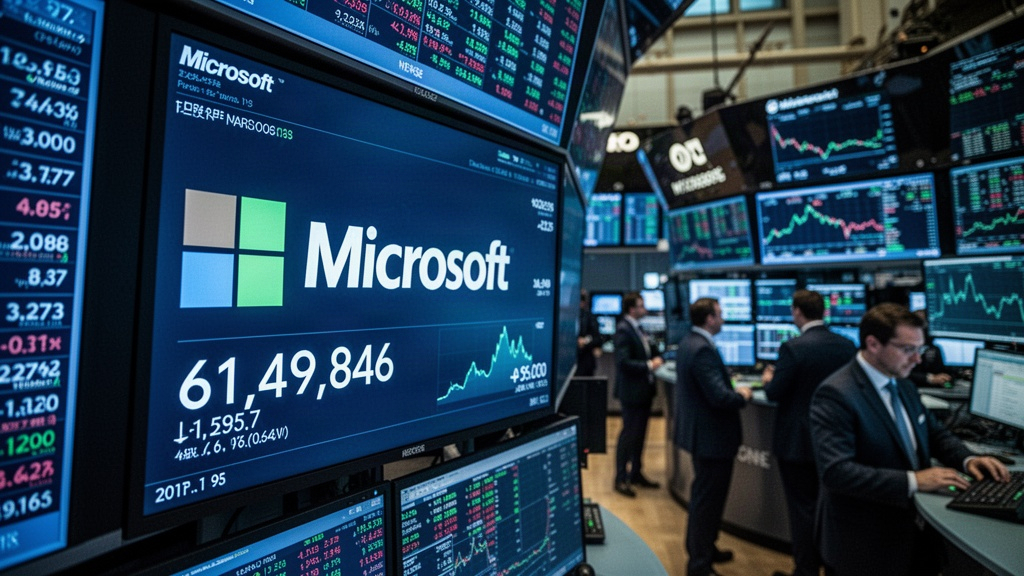
Microsoft stock sits at the center of every serious conversation about large-cap technology investing. Trading at approximately $350 per share in 2026, with a market capitalization hovering around $2.5 trillion, Microsoft Corporation stands as one of the most scrutinized equities on the NASDAQ. Investors ranging from retail traders to institutional funds watch its every move. What actually drives that value, though, goes far beyond a single product launch or quarterly earnings beat. The answer involves a web of financial metrics, competitive positioning, macroeconomic forces, and the collective psychology of millions of market participants. Understanding each of these layers gives any investor — experienced or new — a sharper picture of why this stock behaves the way it does and what signals genuinely matter when evaluating its price.
Understanding What Shapes Microsoft Stock Value
Several distinct forces work together to push Microsoft stock higher or lower on any given trading day. Some are internal to the company, others originate entirely outside it. Recognizing the difference matters enormously when reading price movements.
The most direct internal drivers include:
- Revenue growth — Microsoft's year-over-year revenue growth rate sits around 15%, signaling consistent expansion across its business segments.
- Cloud adoption — Azure's share of enterprise cloud spending directly feeds top-line numbers and margin expansion.
- Product diversification — Windows, Office 365, LinkedIn, and Xbox create multiple revenue streams that reduce dependency on any single market.
- AI integration — Embedding artificial intelligence across the product suite adds perceived long-term earning power, which markets price in ahead of actual results.
External forces carry equal weight. Interest rate decisions by the Federal Reserve alter the discount rate investors apply to future earnings, making high-growth stocks like Microsoft more or less attractive relative to bonds. Broader NASDAQ sentiment also matters — when technology indices fall, Microsoft rarely escapes unscathed, regardless of its own fundamentals. Geopolitical tensions affecting global supply chains or data sovereignty regulations can introduce uncertainty that pressures the share price even when the company itself reports strong numbers.
One angle often underestimated: the weight of index inclusion. Microsoft occupies a top position in the S&P 500 and the Dow Jones Industrial Average. Every passive fund tracking those indices must hold its shares. That structural demand creates a persistent floor under the price that pure fundamental analysis does not fully capture.
Key Financial Metrics Every Investor Should Track
Numbers tell a story, but only the right numbers tell the right one. Three metrics stand out when analyzing Microsoft's market value with any precision.
Earnings Per Share (EPS) measures the profit allocated to each outstanding share. A rising EPS signals that Microsoft is converting revenue into actual shareholder wealth rather than just growing the top line. When EPS beats analyst consensus estimates — which financial analysts at firms like Morgan Stanley or Goldman Sachs publish ahead of earnings — the stock typically gaps up in after-hours trading.
The Price-to-Earnings Ratio (P/E) places the current share price in context. Dividing the share price by EPS reveals how much investors are willing to pay for each dollar of profit. Microsoft has historically traded at a premium P/E compared to the broader market, reflecting confidence in its growth trajectory. A compression of that multiple — even with stable earnings — translates directly into a lower share price.
Market capitalization, calculated by multiplying the share price by total outstanding shares, gives the clearest single-number snapshot of what the market collectively believes the company is worth. At roughly $2.5 trillion, Microsoft competes with Apple and Nvidia for the title of the world's most valuable publicly traded company. Movements in market cap of even 1% represent $25 billion in value created or destroyed — a figure that underscores the sensitivity of large-cap pricing to incremental news.
Free cash flow deserves mention alongside these three. Strong free cash flow funds share buybacks and dividends, both of which directly support the stock price by reducing share count and rewarding holders. Microsoft's track record of consistent buyback programs has contributed meaningfully to its long-term price appreciation.
Broader Market Conditions That Move the Share Price
No stock exists in a vacuum. Macroeconomic cycles shape the environment in which Microsoft's shares trade, sometimes overriding company-specific performance entirely.
The post-pandemic period reshaped technology spending in ways that directly benefited Microsoft. Enterprise customers accelerated digital transformation budgets, driving Azure's growth rate into the double digits for several consecutive quarters. That tailwind eventually moderated, and the market adjusted its growth assumptions accordingly — a normal recalibration that still caused meaningful short-term price volatility.
Inflation and the Federal Reserve's response created a different dynamic. When the Fed raised rates aggressively between 2022 and 2023, growth stocks faced a mathematical headwind: higher rates reduce the present value of future earnings. Microsoft's stock absorbed that pressure before recovering as rate expectations shifted. Monetary policy remains a live variable that investors must factor in when assessing the stock's near-term direction.
Sector rotation also affects pricing. When institutional investors shift capital from technology into energy or financials — often in response to rising commodity prices or yield curve changes — NASDAQ-listed stocks including Microsoft experience selling pressure unrelated to their own performance. Understanding these rotation patterns helps distinguish noise from genuine fundamental deterioration.
Regulatory scrutiny adds another layer. The SEC and international competition authorities have increasingly examined large technology companies for antitrust concerns. Microsoft's acquisition of Activision Blizzard in 2023 faced extended regulatory review in multiple jurisdictions before completion. Each regulatory development created price uncertainty, demonstrating that legal and policy environments directly affect market valuation.
How Investor Sentiment Shapes the Price in Real Time
Markets price expectations, not just facts. Investor sentiment — the collective mood of buyers and sellers — can push Microsoft's stock above or below what pure financial models suggest it should be worth.
Analyst upgrades and downgrades move prices swiftly. When a prominent investment firm raises its price target on Microsoft, institutional funds often adjust positions the same day. The aggregate effect of those adjustments shows up immediately in the share price. Retail investor platforms amplify this dynamic further, since individual traders now access the same real-time data through tools like Yahoo Finance and MarketWatch that were once exclusive to professionals.
Earnings calls carry outsized weight. Satya Nadella's commentary on Azure growth rates or AI monetization timelines during quarterly calls directly shapes the narrative that analysts build into their models. A single cautious phrase about demand softening can trigger a sell-off even when reported numbers exceed expectations — markets trade the future, and management guidance is the clearest window into it.
Short interest data reveals how many traders are betting against the stock. When short interest in Microsoft rises, it signals growing skepticism. A positive catalyst can then trigger a short squeeze, where bearish traders rush to cover positions and inadvertently push the price higher. These dynamics happen in hours, not weeks.
Where the Growth Story Goes From Here
The most compelling long-term driver for Microsoft's valuation is its artificial intelligence strategy. The company's deep investment in OpenAI and the integration of Copilot across Azure, Microsoft 365, and GitHub positions it to capture enterprise AI spending at scale. Analysts project that AI-related revenue could represent a substantial share of total revenue within the next five years, a prospect that already influences current pricing.
Azure's competitive battle with Amazon Web Services and Google Cloud will remain the central story. Cloud infrastructure margins are high, switching costs are significant, and enterprise contracts run for years. Each percentage point of cloud market share Microsoft gains translates into durable, recurring revenue — the type of revenue that commands the highest valuation multiples.
Dividend growth and continued share buybacks provide a floor of tangible shareholder return that pure growth companies cannot offer. This dual appeal — growth potential combined with income — attracts both aggressive and conservative institutional portfolios, broadening the base of demand for the stock.
Risks remain real. A prolonged economic slowdown could compress enterprise IT budgets. Intensifying antitrust scrutiny in the United States and Europe could constrain acquisition strategy. Currency fluctuations affect international revenue when translated back to dollars. None of these risks are existential, but each deserves weight in any honest valuation. Investors who track Microsoft's quarterly filings on SEC.gov and cross-reference them with independent analyst research are best positioned to separate the signal from the noise.